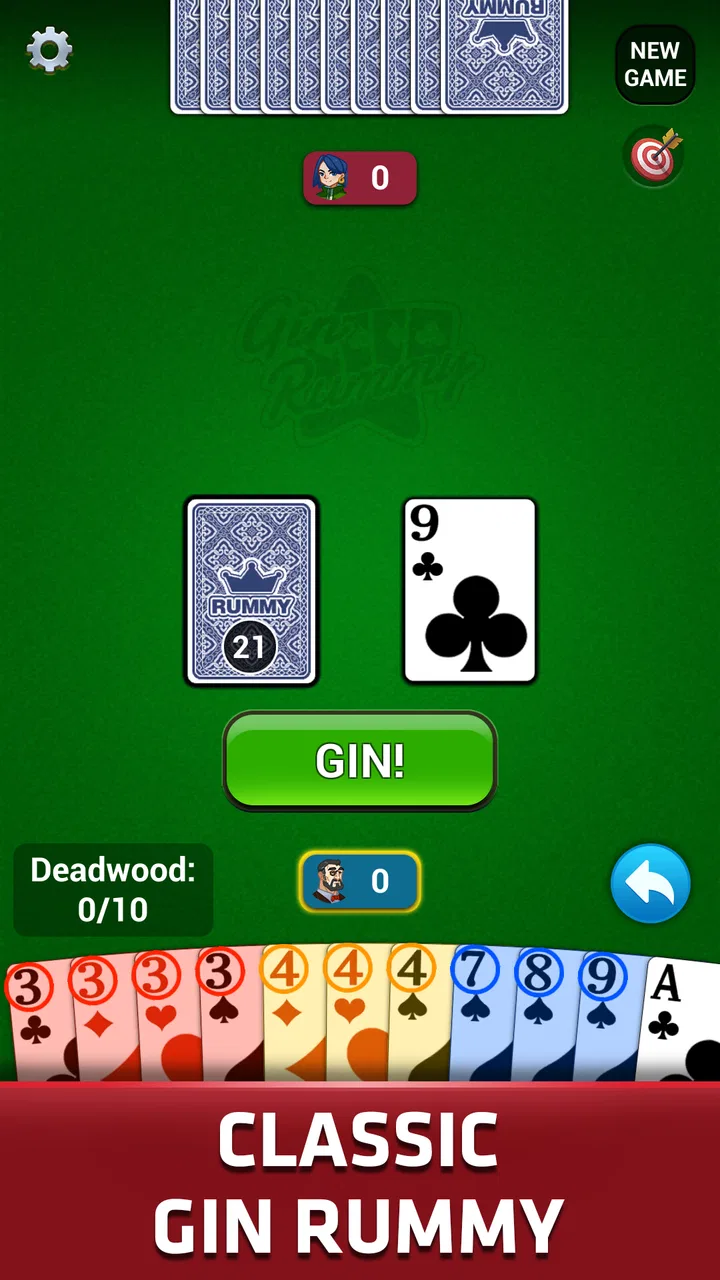
Gin Rummy: Classic Card Game
- 4.9
- Rating
- 5.00M
- Installs
- Free
- Price

 Analysis by App-foxy
Gin Rummy: Classic Card Game is the kind of mobile game I open when I want a quiet challenge rather than a noisy, overcomplicated gaming session. It is a card game from Topy Games, built around the familiar rules of gin rummy and designed to work without an internet connection. I found that combination especially useful during short breaks, travel, or those moments when I want something engaging but do not want to learn a large set of new systems.
The game is free to play and suitable for Everyone, which makes it approachable for families and casual players. It has also attracted a strong audience, with an average rating of 4.9 from around 114 thousand ratings and more than 5 million installs. Those figures do not replace personal experience, but they do suggest that the straightforward card-table format has found the right audience.
What to expect from this gin rummy game
Before installing it, I would set the right expectation: this is not a collectible card game, a multiplayer battle arena, or a story-driven adventure. Its appeal comes from making one traditional card game easy to pick up and replay. You draw, arrange, discard, and try to form useful combinations while keeping an eye on what the other player may be collecting.
You May Also Like

 Blood Strike: 2.5 Anniversary
Blood Strike’s Loadouts Turn Every Drop Into a Tactical Gamble
A close look at Blood Strike’s custom loadouts: how fast access to signature weapons reshapes its battle royale rhythm, rewards preparation, and narrows the gap between fights.

 Pandora - Music & Podcasts
Pandora’s Music Is Easy to Start, but Harder to Recover
Pandora’s strength is its low-effort path from a seed to a station. Its weak spot is how much confidence it asks you to place in connection, setup, and quiet recovery.

 8 Ball Pool
 Is Built on Rivalries, Rematches, and Routine
A close look at the rivalries, rematches, shared routines, and unanswered safety questions that turn a quick pool match into a persistent mobile community.

 Samsung Music
’s Quiet Strength Is Playing What You Already Own
Its reach comes less from spectacle than from dependable access to a personal library. That simplicity is both the app’s strongest retention engine and its ceiling.

 AccuWeather: Weather Radar
AccuWeather Review: A Quick, Clear Forecast for Everyday Decisions
For everyday plans, the best forecast is the one you can understand quickly. AccuWeather makes rain timing, radar, and local conditions easy to act on, with a few trade-offs.

 Hill Climb Racing
Why Hill Climb Racing Still Turns Crashes Into One More Run
A tiny car, a bumpy hill and one more upgrade: Hill Climb Racing keeps resurfacing because its simple chaos makes every near-miss feel personal.
More From Our News Desk



That simplicity is a strength. I can start a round quickly, focus on the hand in front of me, and stop thinking about the game as soon as the round ends. There is no need to remember a long campaign or manage a complicated deck. The challenge comes from small decisions: whether to hold a card for one more turn, whether a discarded card might reveal too much, and when a hand is strong enough to finish.
At the same time, the traditional format may feel too restrained if you prefer constant action or a large variety of modes. The game’s identity is its card-table rhythm. Players who enjoy calm strategy will probably appreciate that focus, while anyone looking for real-time competition, character progression, or a social hub should look elsewhere.
I also like that offline play changes how I use it. A train journey, a waiting room, or a weak-signal area becomes a practical place for a few rounds. It does not need to compete with a streaming service or a demanding online game for attention. That makes it a particularly good choice for a phone that is used as a small, reliable pastime rather than as a full gaming console.
The listing places its release on May 18, 2023, and the current version is 1.9.5.20260414. The minimum operating system is Android 6.0, so the game is aimed at a broad range of Android devices. I would still check that an older phone has enough free space and runs smoothly, but the operating-system requirement itself is not demanding.
Why the first round can feel easier than expected
New players often assume that winning gin rummy means immediately spotting every possible combination. In practice, I found it more useful to begin with a simple sorting habit. I look for pairs of the same rank, then possible runs of consecutive cards in the same suit. I do not try to solve the entire hand at once. I identify one promising group and keep the remaining cards flexible.
This approach makes the first meaningful success feel achievable. Instead of chasing every possible sequence, I ask which cards are already close to becoming useful. A pair can become a set with one matching card, while two neighboring cards can become part of a run. Cards that are isolated and far from any combination are often the easiest discards, although I avoid throwing away a card that the opponent may clearly want.
That last point is where the game becomes more interesting than a simple matching exercise. A card can be valuable because it helps my hand, but it can also be dangerous if I give the opponent an obvious building block. The strongest early habit is therefore to consider both sides of the table before every discard. Even when I am not sure what the opponent holds, I can pay attention to which cards they take and which ones they ignore.
Getting started without overthinking the rules
My recommended first setup is deliberately simple. Install the game, begin a round, and resist the temptation to treat the opening hand as a puzzle that must be solved immediately. Arrange the cards so that potential sets and runs are easy to see. Then choose a single goal for the first few turns: improve one group while keeping the rest of the hand adaptable.
For a first-time player, the most useful question is not “Can I make a perfect hand?” but “Which card gives me the least future value?” This shifts the focus from guessing the entire round to making one sensible decision at a time. If a card does not connect with another card and is unlikely to become useful soon, it is a reasonable candidate for the discard pile.
When drawing, I pay attention to the difference between taking from the visible discard pile and taking from the unseen stock. A visible discard gives information to the other player, but it also gives me certainty about what I am adding. Drawing from the stock hides my intention, though it may produce a card that does not fit. That trade-off is one of the first decisions worth learning.
A practical first-round workflow looks like this:
Sort the hand by rank or suit so possible groups are easy to compare.
Keep cards that already form a pair or sit close to a same-suit sequence.
Discard the least connected card, unless it appears likely to help the opponent.
Watch the opponent’s picks before deciding what to reveal next.
When the hand becomes compact and organized, consider whether finishing is safer than waiting for a perfect improvement.
The important detail is that a good first round does not require a win. If I finish knowing why I kept one card and discarded another, I have already made useful progress. The game rewards that gradual understanding because each round gives immediate feedback on the quality of those choices.
The first successful action I recommend
For someone completely new to the format, I recommend aiming for a small, realistic success: complete one set or one run before trying to optimize the entire hand. A set uses cards of the same rank, while a run uses consecutive cards in the same suit. Once one group is secure, the remaining cards are easier to evaluate.
Suppose I begin with two cards that share a rank and two cards that are close together in the same suit. I would protect both possibilities for a few turns, then compare the new cards I draw with those two plans. If a new card supports the run, I may let the pair go. If it completes the pair into a set, I may stop chasing the sequence. This is more reliable than holding every attractive possibility until the hand becomes crowded with disconnected cards.
One non-obvious lesson is that flexibility has a limit. A hand containing many “almost useful” cards can look promising, but it may produce no completed group. I try to turn possibilities into actual combinations before collecting more possibilities. In other words, two strong partial plans are often better than four vague ones.
Another useful habit is to remember the discard history. I do not need perfect memory. I simply note whether cards near my intended run have already appeared. If several of those cards are gone, continuing to wait for the sequence may be inefficient. I then switch attention to a set, another run, or a lower-risk discard.
This is also where offline play becomes more than a convenience. Because I can play without depending on a connection, I can use short sessions to practice one skill at a time. On one day I might focus on sorting quickly; on another, I might watch the discard pile more carefully. That makes the game suitable for learning in small pieces rather than requiring a long uninterrupted session.
Common confusion and the decisions that matter
The most common beginner confusion is treating every card that could possibly fit as equally valuable. It is not. A card that can join several combinations is flexible, while a card that only works with one rare possibility is fragile. I usually keep flexible cards a little longer and discard narrow ones when the hand starts to stagnate.
Players can also misread the discard pile as a free source of useful cards. Taking a visible card may improve the hand immediately, but it announces something about the combination I am building. If I repeatedly take cards that reveal the same suit or rank, the opponent receives clues. Sometimes drawing from the stock is worthwhile simply to keep my plan less obvious.
There is a similar trade-off when discarding a card that seems harmless. A card that does not help me may be exactly what the opponent needs. I cannot know the full opposing hand, so I use the recent picks as evidence. If the opponent has taken cards from one suit, I become more cautious about discarding nearby cards in that suit. This does not require advanced counting; it is just disciplined observation.
Another point new players often miss is the cost of waiting. Holding a weak card for too long can prevent the rest of the hand from becoming organized. I used to keep an attractive pair while ignoring several isolated cards, only to end with a hand that had potential but no clear finish. Now I set a rough limit: if a plan has not improved after several opportunities, I reassess it instead of defending it emotionally.
The game is also not the best fit for every kind of card player. If you want a large deck-building system, frequent new content, or a strong online community, this focused format may feel narrow. Likewise, players who dislike repeated rounds with similar basic rules may lose interest after the novelty fades. I would choose a broader card platform for variety and social interaction, but I would choose this one for quick, self-contained practice.
Compared with playing gin rummy with physical cards, the mobile version removes setup time and makes solo practice much easier. I do not need another person available, a table, or a deck that has not lost any cards. The trade-off is that a phone screen provides less social warmth than a face-to-face game. For a family gathering, physical cards may still be better; for a five-minute break, the app is more convenient.
Compared with more elaborate digital card games, this title is easier to understand because the rules stay at the center. There are fewer distractions competing with the hand. That makes it a good introduction for someone who has heard of gin rummy but never played seriously. It also makes it a useful refresher for an experienced player who wants to rebuild instincts without learning a new ruleset.
Small techniques that improve everyday play
My first practical technique is to separate “useful now” from “useful in theory.” A card may technically complete a combination later, but if the required cards are unlikely to appear or have already been discarded, it is not helping the current hand. I make decisions based on the live possibilities rather than the most attractive imaginary one.
My second technique is to avoid revealing a pattern too early. If I already have a strong run developing, I do not automatically take every visible card that extends it. Sometimes a less informative draw keeps the opponent uncertain and gives me time to improve another part of the hand. This is a trade-off, not a universal rule: when the visible card is exactly what I need and the hand is close to completion, certainty can matter more than secrecy.
My third technique is to use short sessions intentionally. Instead of playing until I become careless, I stop after a few focused rounds and remember one decision that worked and one that did not. This is especially effective for a quiet offline game because there is no pressure to remain connected or keep up with other players. The app fits naturally into a routine of small practice sessions.
A fourth insight is that the opponent’s discard behavior can be more informative than a single card they take. One pick may be random or merely convenient, but repeated choices can suggest a direction. I do not try to reconstruct the entire opposing hand. I only use that pattern to avoid making generous discards and to decide when a visible card is too revealing.
These techniques also explain why the game can remain interesting after the basic rules become familiar. The challenge gradually moves from identifying combinations to managing information. I am not only asking what improves my hand; I am asking what my choices communicate and how much uncertainty I can preserve.
Who will enjoy it and what to know before choosing it
I would recommend this game to a first-time gin rummy player, someone who enjoys traditional card strategy, and anyone looking for a free game that can be played offline. It is particularly comfortable for people who prefer thoughtful turns over rapid tapping. The Everyone age rating also makes it a reasonable option for households looking for a simple card game without an aggressive presentation.
It is a good match for a daily commute, a lunch break, or a quiet evening when I want a little mental activity without committing to a long session. The rounds give me a clear beginning and end, so I can put the phone away without leaving a complicated campaign unfinished. That sense of control is one of its strongest everyday advantages.
I would skip it if my main priority is live competition with friends, constant content updates, or a deep progression system. I would also skip it if I find traditional card games repetitive by nature. The app does not need to disguise its simplicity, and players should not expect it to become something fundamentally different from gin rummy.
Because it is free, it is easy to try without making the decision feel significant. Still, I would judge it by whether the core loop suits me after several rounds, not by the first hand alone. Card games can feel dull when luck goes against me, and a short losing streak may make the decisions seem less meaningful than they really are. Giving the game enough time to notice the strategic choices is important.
For a first-time user, my next step would be to play a few rounds with one narrow objective: form a clean combination, track the discard pile, and avoid holding isolated cards indefinitely. Once that feels natural, I would start paying attention to what my discards reveal. That progression turns a basic time-killer into a more deliberate strategy exercise.
Overall, Gin Rummy: Classic Card Game succeeds because it stays focused. Topy Games has made a free card game that is easy to enter, practical offline, and deep enough to reward better observation. It is not the right choice for players seeking a busy multiplayer experience, but for calm, repeatable gin rummy sessions, its greatest strength is the balance between immediate play and slowly improving judgment.
The game has been reviewed positively by a large player base, including around 1.4 thousand written reviews, and its current release keeps it suitable for modern Android use while supporting devices from Android 6.0 onward. I would recommend trying it when I want a familiar game with meaningful decisions but very little setup. The first success is simple: make one sensible group, discard with purpose, and let the next round teach me a little more.
FAQs for Gin Rummy: Classic Card Game
01What are the main features of Gin Rummy: Classic Card Game?
Gin Rummy: Classic Card Game offers a user-friendly interface with smooth gameplay, allowing you to enjoy classic Gin Rummy rules. It includes customizable themes, intuitive controls, and detailed statistics to track your progress. The app also supports both single-player mode against AI and multiplayer mode to challenge friends or players worldwide.
02Is Gin Rummy: Classic Card Game free to play?
Yes, the game is free to download and play. However, it offers in-app purchases for premium features, such as ad removal and additional themes. While the free version includes ads, they are unobtrusive, and the core gameplay remains accessible without spending money.
03Does the game require an internet connection?
Gin Rummy: Classic Card Game can be played offline in single-player mode, making it perfect for on-the-go gaming. However, an internet connection is required for multiplayer matches and for accessing certain features like leaderboards and social interactions.
04How does the multiplayer feature work?
The multiplayer feature allows you to compete against friends or random players online. You can create private rooms to invite friends or join public matches. The game uses a matchmaking system to pair you with opponents of similar skill levels, ensuring challenging and balanced gameplay.
05Are there any tutorials or guides available for new players?
Yes, the app includes a comprehensive tutorial for beginners, explaining the rules and strategies of Gin Rummy. This helps new players understand the game mechanics quickly. Additionally, there are hints and tips provided during gameplay to assist players in improving their skills.
Pros
- Smooth and intuitive user interface.
- Engaging graphics with classic feel.
- Multiplayer mode is seamless.
- Offers daily bonuses and rewards.
- Low battery consumption.
Cons
- Ads can be intrusive at times.
- Limited customization options.
- Requires internet for multiplayer.
- Occasional connection issues.
- No tutorial for beginners.

Gin Rummy: Classic Card Game
Gallery